

Backorders Are Lead-Time Data: What a Supplier's Slip Tells You
A backorder notice is a lead-time observation. Record three dates and the reason, count each supplier's backorder rate, and size your buffers and second sources from the measured slip.
A backorder notice is lead-time data from the supplier's own records. It arrives after they accepted the order, it names a part, and it carries a date they could not keep. If you file it as an interruption and chase the new date, you lose three numbers. Those numbers tell you how much buffer that supplier's parts need, which dates to confirm earlier, and where a second source would pay for itself. The backorder lesson covers what to do on the day. This piece covers what to keep.
Why is a backorder different from a late delivery?
A late delivery is a date that passed. A backorder is a date the supplier withdrew, in most cases before it passed, with a reason attached. The timing is what you can use. The supplier has looked at their stock and told you, in advance, that the acknowledgement was wrong.
A quoted lead time is a forecast the supplier makes before they have your order. A backorder is a correction they make after. Between the two sits the number you plan with: the lead time your POs take, measured from order to dock. Supplier lead times argues that the spread of that number matters more than its length. Backorders cause much of that spread.
What should you record when a line goes on backorder?
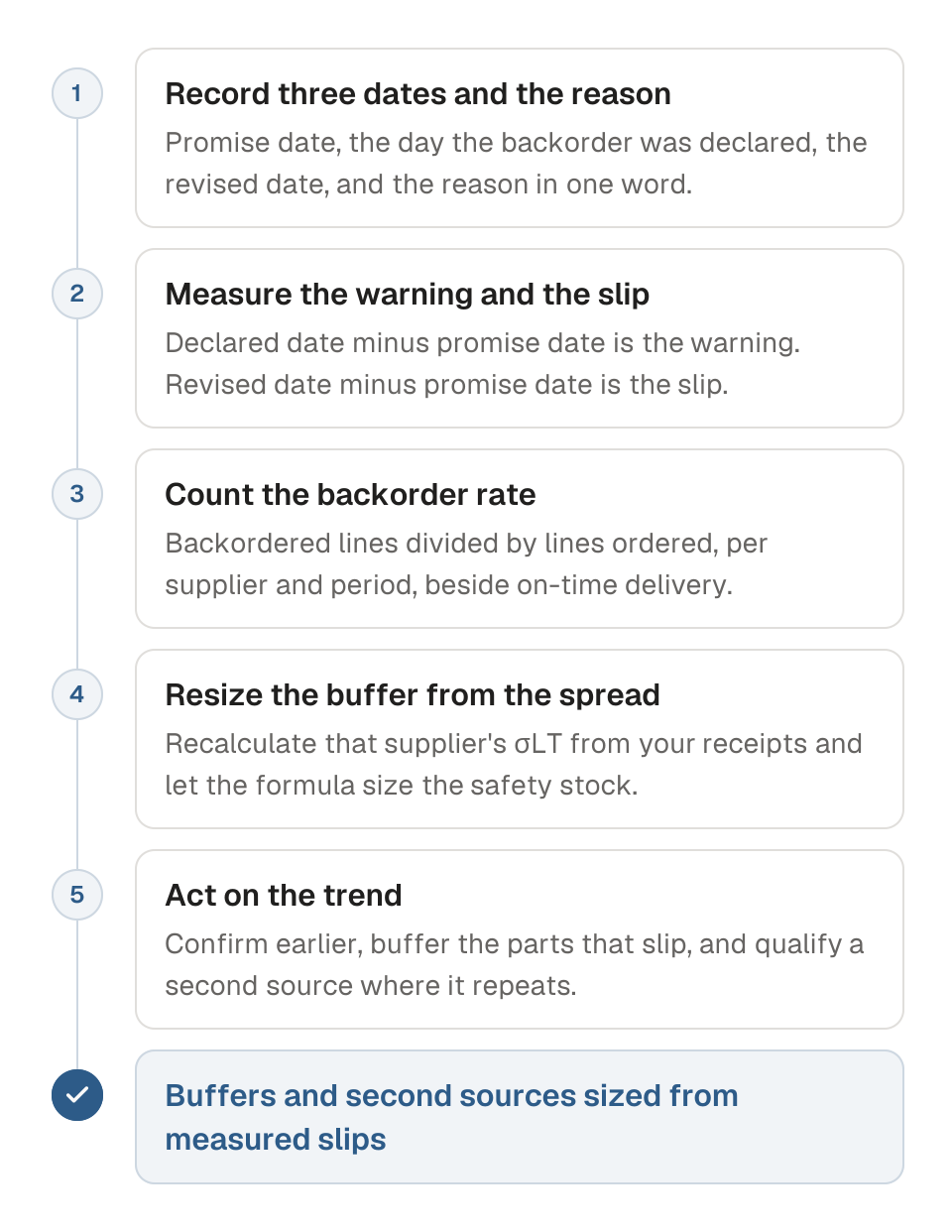
Record three dates on the line and keep all of them. The promise date from the acknowledgement, the date the supplier declared the backorder, and the revised ship date they committed to. Add the reason they gave, in one of five words: demand, material, production, allocation or discontinued.
The first two dates measure how early the supplier warns you. A supplier who declares a backorder three weeks before the promise date is giving you time to recover. One who declares it the day after is giving you a past-due line with a new name. The gap between the promise date and the revised date is the slip. Put the slip in the same set of lead-time observations you use to size safety stock.
| Field | Example | What it measures |
|---|---|---|
| Promise date | 12 November | What the supplier committed to |
| Declared on | 30 October | How much warning you got: 13 days |
| Revised date | 3 December | The slip: 21 days |
| Reason | Allocation | Whether stock exists and went elsewhere |
| Split offered | 400 of 1,000 | What can cover the next build |
How does a supplier's backorder rate change your safety stock?
Safety stock covers two risks: use that runs above plan, and deliveries that arrive late. For most purchased parts with lead times over a month, the lead-time term dominates. That term is driven by how much delivery dates move. A supplier who backorders one line in twenty moves your dates more than one who backorders one in two hundred.
Count how often each supplier does it. A supplier's backorder rate is the share of PO lines they put on backorder in a period. Divide backordered lines by lines ordered. Track it beside their on-time delivery, because the two measure different failures. A supplier can be on time on nine lines in ten and still backorder the tenth for six weeks. That tenth line stops the build.
When the rate rises, do not raise safety stock across the board. Recalculate the lead-time spread for that supplier from your own receipts, including the backordered lines. Then let the safety stock formula size the buffer from the new spread. The buffer grows only on the parts that supplier slips, so the cash goes where the risk is.
| Supplier | Backorder rate | Lead-time spread (σLT) | Safety stock at 95% |
|---|---|---|---|
| A | 1 line in 200 | 3 days | 505 units |
| B | 1 line in 20 | 9 days | 1,490 units |
The example uses 100 units a day of use, a standard deviation of 30, and a 30-day average lead time. The part and the demand are the same. Supplier B's backorders triple the buffer you have to hold. That cost belongs in the next price negotiation with B, or in the business case for a second source.
Why is "a few weeks" never an acceptable answer?
You cannot plan a line against "a few weeks". In most cases the phrase means the supplier has not checked. Ask for the day, and ask what it rests on. It may be stock already allocated to you, a production run with a start date, or an inbound shipment from their own supplier. Each answer carries a different risk, and only the first one is a commitment.
The same discipline applies to split shipments. A supplier who has part of the quantity will often offer to ship it, and that offer is worth taking on your terms. You decide whether to accept a partial delivery, and the fair trade for accepting one is a dated commitment on the balance. Get both in writing on the same day.
What do you change once the data is in?
Change three things, in the order they pay back. First, confirm earlier. If a supplier's backorders arrive with little warning, move your status check ahead of their promise dates. The backorder then reaches you with time to recover. Purchase order tracking sets that rhythm.
Second, size the buffer from the measured spread, supplier by supplier. A rising backorder rate should show up as a larger σLT in the formula within the quarter, before anyone adds a round number after a line stops.
Third, qualify a second source for the parts that repeat. A backorder rate is a readiness signal for every open line you hold with that supplier. A supplier who backorders the same part family twice a year has shown you where to spend the qualification budget. Dual sourcing covers how to do it without doubling the tooling.
How do you keep this up without a spreadsheet nobody maintains?
Someone has to capture the three dates and the reason on the day the notice arrives, or the record is lost. Cartograph reads the supplier's reply and puts the revised date on the PO line beside the original promise date. The backordered balance stays visible until it is received. When a line reaches its promise date with nothing received, a readiness signal opens a task. Scout Agent asks the supplier for the date and what it rests on. The backorder rate per supplier falls out of that record. Cartograph does not set your safety stock or choose your second source. It keeps the data those decisions need.
Questions teams ask
Is a backorder the supplier's fault?
Not always, and the warning matters more than the fault. A supplier whose own supplier failed may still warn you early and offer a split. Judge suppliers on how early they declare and how firm their revised dates prove to be.
Should a backorder count against on-time delivery?
Yes, once the original promise date passes without receipt. Count the backorder rate on its own as well. A supplier can recover a backorder before the promise date and still be telling you something about their stock discipline.
What is a good backorder rate for a supplier?
There is no published benchmark for purchased parts in a plant. Compare each supplier with their own history and with the other suppliers of the same part family, and act on the trend.