

Backorder meaning: what to do when a supplier backorders your PO
What a backorder is, how it differs from out of stock, and the four steps to take when a supplier backorders a purchase order line before it stops a build.
A backorder is an order line the supplier has accepted but cannot ship yet. The item is out of stock at their end. The line stays open at the agreed quantity and price, and the supplier owes you a new ship date. For a plant, one question matters: does the new date land before the build that needs the part?
What is a backorder?
A backorder is an accepted order for an item the supplier has run out of for now. The supplier holds the line open until supply returns. Three other statuses look similar on a screen. An out-of-stock item has no restock date, so no order can be placed against it. A pre-order is for a product that has not been made yet. A backlog is every unfilled order a supplier holds, whatever the reason, so a backlog can be large while nothing is on backorder.
The table below puts the four side by side.
Backorder, out of stock, pre-order and backlog
A table comparing four supplier statuses. A backorder is an accepted order for a temporarily out-of-stock item; the line stays open and a revised ship date is owed. Out of stock means no restock date, so no order can be placed. A pre-order is for a product not yet made, with a planned release date. A backlog is every unfilled order the supplier holds, whatever the cause, and has no single date. The table also shows what the buyer holds in each case: an open line at the agreed quantity and price for a backorder, nothing for out of stock, a reservation for a pre-order, and a place in a queue for a backlog.
| Status | What the supplier is saying | Date you can expect | What you hold |
|---|---|---|---|
| Backorder | Accepted, out of stock for now, will ship when supply returns | A revised ship date, owed to you in writing | An open line at the agreed quantity and price |
| Out of stock | No stock and no restock date, so no order is taken | None | Nothing; the line cannot be placed |
| Pre-order | The product is not made yet; orders are taken ahead of release | A planned release date | A reservation against the first production |
| Backlog | Unfilled orders of every kind, whatever the cause | None in particular | A place in the queue, not a date |
Only a backorder leaves you an open line with a quantity, a price and a date the supplier owes you.
Suppliers also use the word for part of a line. A partial backorder means some of the quantity ships now and the rest follows. A rolling backorder means the supplier keeps moving the date without committing to one. Treat a rolling backorder as a line with no date, and work it as supplier not responding describes.
What does it mean when a supplier puts your PO line on backorder?
When a supplier marks your purchase order line as backordered, they are telling you three things. They accepted the line and still intend to fill it. They have no stock to ship against it today. And the promise date on their acknowledgement no longer holds, so the line now needs a new one.
Two things stay as they were. The quantity and the price stand as ordered, unless you agree otherwise. The line is not cancelled, and it is not closed short. If the supplier wants to close the balance, that is a different conversation. Have it in writing before your ERP shows the line as complete.
A backorder is not the same as a long lead time. A lead time is quoted before you order, and you plan around it. A backorder appears after the supplier accepted the order, so a commitment slipped, and you have to recover the days it cost. Supplier lead time covers what a quoted lead time often leaves out.
How long do backorders take?
A backorder lasts as long as the supplier's own replenishment takes, and only the supplier can tell you that. For stocked catalogue items the wait is often days to a few weeks. For a made-to-order part, a raw material shortage or a quality hold, it can run for months.
The only number that matters for your build is the revised ship date, in writing, against the line. Ask for the date before you ask for the reason, so the line stops being risk you cannot size. Ask what the date rests on. It may be stock already allocated to you, a production run with a start date, or an inbound shipment from their supplier. Prefer a later date with evidence to an earlier one without. Past-due purchase orders covers why the date comes before the cause.
Log the revised date on the PO line the way you would log any acknowledgement, and keep the original promise date beside it. The gap between the two is the supplier's slip. You will want that number when you review the supplier.
Why do suppliers backorder?
Suppliers backorder a line for one of five reasons, and each reason points to a different recovery. Demand outran their stock, often because several customers ordered at once. Their own supplier or raw material is late. A production run slipped or a lot is held in quality. They are allocating scarce stock across customers, and your order ranked below someone else's. Or they have discontinued or superseded the part, and the backorder is a holding status until they tell you.
Ask which one applies. A stock-out that a scheduled production run will cover needs a date and nothing more. An allocation problem needs an escalation, because the stock exists and another customer is getting it. A superseded part needs engineering, because the date may never come. Expediting maps each cause to the levers that fit it.
What should you do first when a PO line goes on backorder?
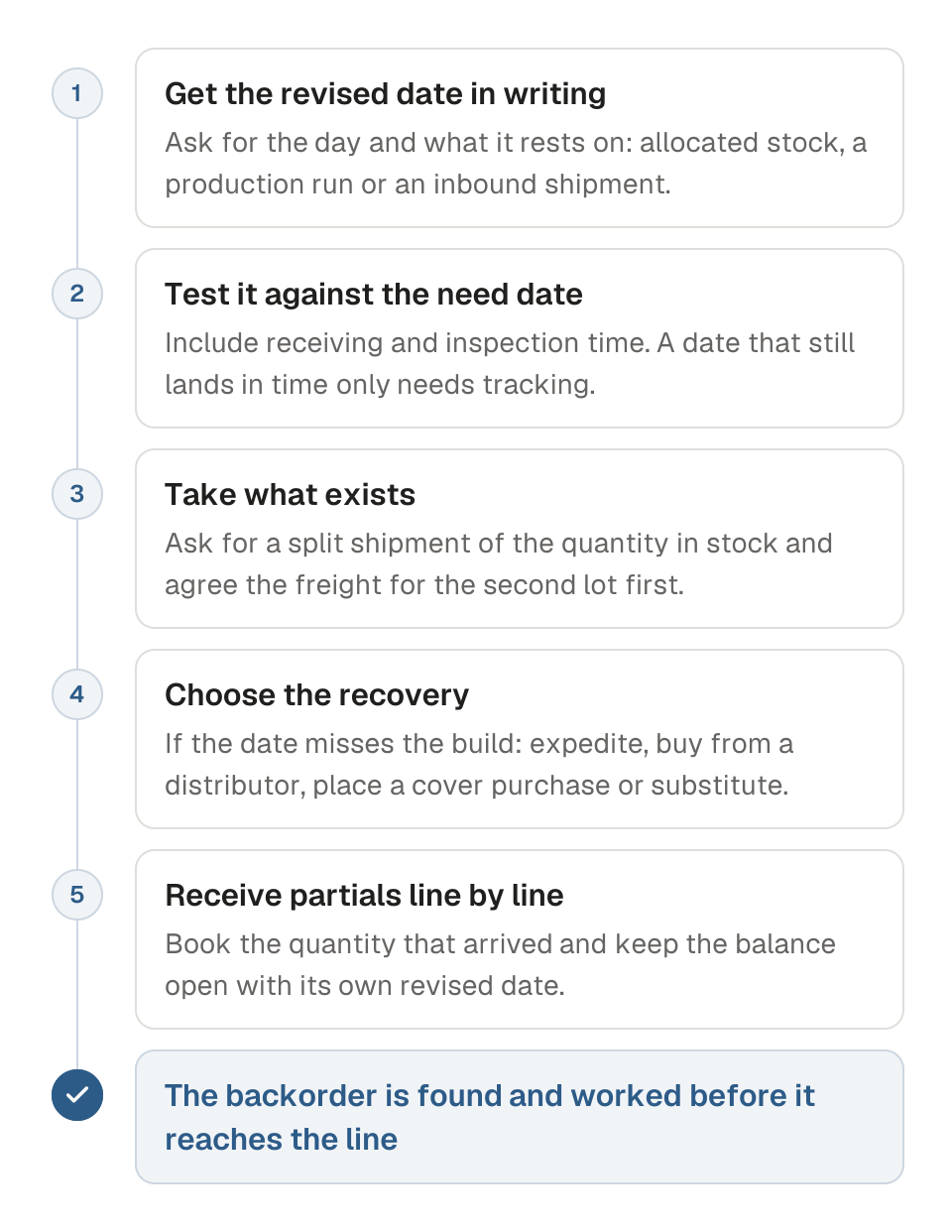
Work a new backorder through four steps, in this order, on the day you learn of it.
The first four steps when a PO line goes on backorder
A four-step sequence for a newly backordered purchase order line. Step one: get a specific revised date in writing and record it on the line. Step two: check the revised date against the need date, with receiving and inspection time included; if it still lands in time, track the line. Step three: ask for a split shipment of the quantity that exists, and agree the freight for the second lot before accepting. Step four: if the revised date misses the need date, choose a recovery, from expediting with the current supplier, through an authorized distributor or a cover purchase, to an engineering substitute.
- 1
Get the date
- Do this
- Ask for a specific revised ship date in writing, with the evidence it rests on
- Why first
- A line without a date is risk you cannot size
- Then
- Record it on the PO line beside the original promise date
- 2
Test it against the build
- Do this
- Compare the revised date with the need date, including receiving and inspection time
- Why first
- Most backorders still land in time and only need tracking
- Then
- If it lands in time, track the line; if not, go to step 3
- 3
Take what exists
- Do this
- Ask for a split shipment of the quantity in stock
- Why first
- Part of the quantity can cover the next build
- Then
- Agree the freight for the second lot before you accept the split
- 4
Choose the recovery
- Do this
- Expedite, buy from an authorized distributor, place a cover purchase, or ask engineering for a substitute
- Why first
- The gap left after steps 1 to 3 is the gap worth paying to close
- Then
- Own the decision and log it with the cause and approver
Get the date, test it against the build, take what exists, then decide. The cheap steps come first.
First, get a specific revised date in writing and record it on the line. If the supplier says "a few weeks", ask for the day and for the evidence behind it.
Second, check the line against the need date. Include your receiving and inspection time. If the revised date still lands before the build needs the part, the line only needs tracking. Promise date vs need date covers how to compare the two, and clear to build covers how the check runs across a whole kit.
Third, ask for a split shipment of whatever exists. If the supplier has part of the quantity, that part can cover the next build while the balance follows. Agree the freight terms for the second lot before you accept, since a split adds handling, paperwork and sometimes a second freight charge.
Fourth, if the revised date misses the need date, choose a recovery and put your name on the decision. The options, in rough order of cost, are four. Expedite with the current supplier. Buy the balance from an authorized distributor. Place a cover purchase with a second source. Or ask engineering for a substitute. Expediting lays out all the options with their time to take effect and their risks.
In the United States
Under the UCC, as enacted in most states, all goods called for by a contract must be tendered in a single delivery unless the parties agreed otherwise. A buyer therefore need not accept a split shipment the supplier proposes on its own. UCC §2-307. When a delivery falls short of the contract, the buyer has three options. Reject the whole, accept the whole, or accept any commercial unit and reject the rest. UCC §2-601. Accepting the quantity that exists and keeping the balance open is the buyer's choice. It is worth trading for a firm date on the balance.
Where the order or agreement calls for deliveries in separate lots, such as releases under a blanket order, the installment rules apply. A short installment can be rejected only if the shortfall substantially impairs the value of that installment and cannot be cured. A default on one or more installments breaches the whole contract only if it substantially impairs the value of the whole. UCC §2-612. Check your contract and counsel before you cancel a balance.
Selling into the EU?
EU law doesn't harmonize the rules on partial delivery between businesses, so German law is shown here. A supplier isn't entitled to perform in parts, so you may refuse a split shipment the supplier offers on its own. § 266 BGB. Agreeing to one is a concession, and a fair thing to ask for in return is a dated commitment on the balance.
The CISG applies to a cross-border sale between businesses in different Contracting States, every EU member state but Ireland and Malta. Under it, a delivery of only part of the goods leaves the buyer's remedies in place for the missing part. The buyer may fix an additional period of reasonable length for delivery of that part. Avoiding the whole contract needs a shortfall that amounts to a fundamental breach. Contracts can exclude the CISG. CISG Arts. 1, 6, 47(1) and 51.
How do you record a partial delivery against a backordered line?
Receive a partial delivery line by line, for the quantity that arrived, and leave the balance open on the PO. Do not mark the whole line received to clear it from a report. If you close the line early, planning loses sight of the backorder and three-way matching breaks when the second invoice arrives. Accounts payable can then pay the supplier for parts that never shipped.
Keep the backordered balance visible with its own revised date, so MRP plans against the real arrival. If your ERP cannot hold two dates on one line, split the line into the received quantity and the open balance. Receiving inspection covers what the first lot still has to pass before it counts as available.
How do you keep backorders from stopping builds?
A backorder stops a build when you find it late. A backorder notice that sits unread in an inbox for a week costs you the week you needed to recover. Treat every open PO line that reaches its promise date with nothing received as a possible backorder. Ask for status before the date passes.
Track the backordered lines on the open PO report with the revised date, the need date and the build each line feeds. You can then work the line that threatens next week's schedule before the one that can wait. Purchase order tracking describes that routine, and the open PO tracker builds the report from your PO data. When a line comes due with nothing received, a readiness signal opens a task. Cartograph hands it to your team or Scout Agent, who emails and calls the supplier for the revised date and its evidence. Scout Agent works within the permissions your team sets.
Count how often each supplier backorders. A supplier's backorder rate is the share of PO lines they put on backorder in a period. Divide backordered lines by lines ordered. A rising rate is a readiness signal for every open line you hold with them. Raise safety stock on their parts, confirm dates earlier, or qualify a second source before the next slip. Dual sourcing covers how to qualify one.
Questions teams ask
Can you cancel a backordered PO line?
Yes, in most cases, if the supplier has not shipped and your purchase terms allow cancellation of unshipped quantities. Check the terms first, cancel in writing, and get the supplier's confirmation that the balance is closed before you order elsewhere.
Does backordered mean discontinued?
No. A backorder means the item is expected back in stock. Ask whether the part is discontinued or superseded. Some suppliers hold a line on backorder while they decide, and that date never comes.
What is a partial backorder?
A partial backorder is a line where part of the quantity ships now and the rest follows later. Receive the first lot for its actual quantity and keep the balance open with its own revised date. Agree the freight for the second lot before you accept the split.
Is a backorder the same as a late delivery?
A backorder is one cause of a late delivery, and the supplier declares it before the date passes. A late delivery is any line you have not received by its promise date, whatever the reason. Ask the same first question in both cases: what is the new date, and what does it rest on?
If your team learns about backorders from unread emails, talk to our team. Cartograph's readiness signals open a date request as each line comes due.
Cartograph's articles are general information, not legal or tax advice. Check how the rules apply to your business with your legal or tax advisor.
Sources (6)
- UCC §2-307, Delivery in Single Lot or Several Lots (Cornell LII)
- UCC §2-601, Buyer's Rights on Improper Delivery (Cornell LII)
- UCC §2-612, "Installment contract"; Breach (Cornell LII)
- § 266 BGB, Teilleistungen
- United Nations Convention on Contracts for the International Sale of Goods (UNCITRAL), Arts. 1, 6, 47 and 51
- UNCITRAL, CISG status table (Contracting States)