

Kraljic matrix: sort purchased parts by supply risk and profit impact
What the Kraljic matrix is, how to score supply risk and profit impact for purchased parts from your own PO data, and the sourcing action each quadrant calls for.
The Kraljic matrix sorts what you buy into four groups by two questions. How much does the part affect profit, and how hard is it to get? Each group gets a different sourcing approach. In a plant, the matrix pays off when you score supply risk from your own purchase order history and when each quadrant tells the buyer what to do before the build date.
What is the Kraljic matrix?
The Kraljic matrix is a two-by-two grid for purchased items. One axis is profit impact: how much the item matters to cost, margin or output. The other is supply risk: how many sources exist, how long the lead time runs, and how often supply fails. The grid gives four quadrants, called strategic, leverage, bottleneck and non-critical. Peter Kraljic published it in the Harvard Business Review in 1983, in an article titled "Purchasing Must Become Supply Management". Buyers still use the names he chose.
The matrix classifies items and categories. It does not classify suppliers. One supplier can sell you a strategic casting and a non-critical fastener, and the two need different handling. Score the part, and let the supplier's treatment follow from the parts you buy from them.
What are the four quadrants?
The table below gives the four quadrants, what puts a part in each, and the approach that fits.
The four Kraljic quadrants for purchased parts
A table of the four Kraljic matrix quadrants. Strategic: high profit impact and high supply risk, for example a sole-source machined housing with a four-month lead time; the approach is long-term agreements, a second source where one can be qualified, and scheduled business reviews. Leverage: high profit impact and low supply risk, for example sheet steel or standard bearings; the approach is competition and volume consolidation. Bottleneck: low profit impact and high supply risk, for example a seal that one coater finishes; the approach is safety stock, early PO confirmation and an engineering alternative. Non-critical: low profit impact and low supply risk, for example fasteners and gloves; the approach is a catalogue contract with automatic replenishment.
| Quadrant | Profit impact | Supply risk | Typical part | Approach |
|---|---|---|---|---|
| Strategic | High | High | Sole-source machined housing, four-month lead time | Long-term agreement, second source where possible, scheduled business reviews |
| Leverage | High | Low | Sheet steel, standard bearings, packaging | Competition between sources and volume consolidation |
| Bottleneck | Low | High | Seal finished by one coater, obsolete connector | Safety stock for a full lead time, early PO confirmation, engineering alternative |
| Non-critical | Low | Low | Fasteners, labels, gloves | Catalogue contract with automatic replenishment |
Bottleneck parts cost little and still stop the line, so inventory and early confirmation protect them.
Strategic parts carry high profit impact and high supply risk. A machined housing from a sole source with a four-month lead time is strategic. These parts need long-term agreements, a second source where one can be qualified, and a business review with the supplier on a calendar. Leverage parts carry high profit impact and low supply risk. Sheet steel, standard bearings and corrugated packaging sit here for most plants. Many suppliers can make them, so competition and volume consolidation set the price.
Bottleneck parts carry low profit impact and high supply risk. A small seal that only one coater can finish, or an obsolete connector, sits here. The part costs little, and a shortage still stops the line. Non-critical parts carry low profit impact and low supply risk: fasteners, labels, gloves. Ordering them often costs more than the part itself, so the approach is to spend as little attention on them as you can.
How do you score supply risk for a purchased part?
Score supply risk from numbers your purchase orders already hold, and let opinion break ties. Four measures cover most of the risk. Count the approved sources: one source is the highest risk, three or more the lowest. Measure the actual lead time from order to dock on your own receipts, because a part that takes four months gives you four months of exposure. Take the supplier's on-time delivery and backorder rate on that part over the last year. Check whether the part depends on a single sub-tier, such as one foundry or one coating line that several of your suppliers share.
Give each measure a score of one to three and add them. A part with one source, a 120-day lead time, a backorder every tenth line and a shared sub-tier scores twelve, the ceiling. A catalogue part with three distributors, two weeks of lead time and clean receipts scores four. Put the cut between low and high risk where your parts split. Sole source vs single source covers how to count sources honestly, and supply concentration risk covers the shared sub-tier.
How do you score profit impact without using spend alone?
Spend is the usual stand-in for profit impact, and it misleads in a plant. Spend ranks a high-volume commodity above a cheap part that stops the line. Score profit impact on two measures instead. The first is annual spend. The second is the cost of a stock-out, which is the value of the builds the part gates over its lead time.
For example, a bracket costs four dollars and you buy eight thousand a year, so spend is low. The bracket goes into every unit of a product that ships at two hundred units a week. A six-week backorder gates twelve hundred units of finished goods. The stock-out cost is high, and the part scores high on profit impact. A bar stock you spend three hundred thousand a year on, with a two-week lead time and four mills, scores high on spend and low on stock-out cost. Add the two scores. A part scores high on profit impact when either measure is high.
How do you place a part and choose the action?
Place each part by its two scores, then read the action from the quadrant. The worked example below runs four parts through the scoring.
Four parts scored and placed
A worked example scoring four purchased parts. Supply risk adds four scores of one to three: approved sources, actual lead time, delivery record and shared sub-tier. Profit impact adds two scores: annual spend and stock-out cost. A machined housing scores eleven on risk and six on impact, strategic. Bar stock scores five on risk and four on impact, leverage. A coated seal scores ten on risk and three on impact, bottleneck. Nitrile gloves score four on risk and two on impact, non-critical. The last column gives the action for each.
| Part | Supply risk (sources + lead time + delivery + sub-tier, max 12) | Profit impact (spend + stock-out cost, max 6) | Quadrant | Action |
|---|---|---|---|---|
| Machined housing | 11 (1 source, 120 days, backorders, own foundry) | 6 (high spend, gates every unit) | Strategic | Qualify a second source, sign a long-term agreement, quarterly business review |
| Bar stock | 5 (4 mills, 14 days, clean receipts, no shared tier) | 4 (high spend, low stock-out cost) | Leverage | Yearly bid across the four mills, consolidate volume |
| Coated seal | 10 (1 coater, 90 days, late lines, shared coating line) | 3 (low spend, gates one product) | Bottleneck | Safety stock for a full lead time, early PO confirmation, ask engineering for a standard seal |
| Nitrile gloves | 4 (3 distributors, 7 days, clean receipts, no shared tier) | 2 (low spend, no build gated) | Non-critical | Catalogue contract with automatic replenishment |
The seal costs cents and scores ten on supply risk. It gets safety stock and early confirmation, because its spend will not pay for a second-source project.
The housing lands in strategic. The buyer opens a second-source qualification and a long-term agreement, and puts the supplier on a quarterly business review. The bar stock lands in leverage, so the buyer runs a yearly bid across the four mills and consolidates volume for price. The seal lands in bottleneck. The buyer raises safety stock to cover a full lead time, confirms every PO early, and asks engineering whether a standard seal would do. The gloves land in non-critical, so the buyer moves them to a catalogue contract with automatic replenishment and stops looking at them.
Bottleneck parts deserve the most attention per dollar. Their spend is too small to justify a second-source project, so the protection comes from inventory, early confirmation and an engineering alternative. Dual sourcing covers when a second source pays back, and the safety stock calculator sizes the buffer from the part's measured lead-time spread.
What are the common mistakes with the Kraljic matrix?
Three mistakes leave most matrices in a slide deck. The first is scoring suppliers instead of parts, which hides the bottleneck part a big supplier sells you alongside their leverage parts. The second is using spend as the vertical axis, which pushes cheap line-stopping parts into non-critical, where nobody watches them. The third is scoring once, which leaves a part in leverage after its second source has left the market.
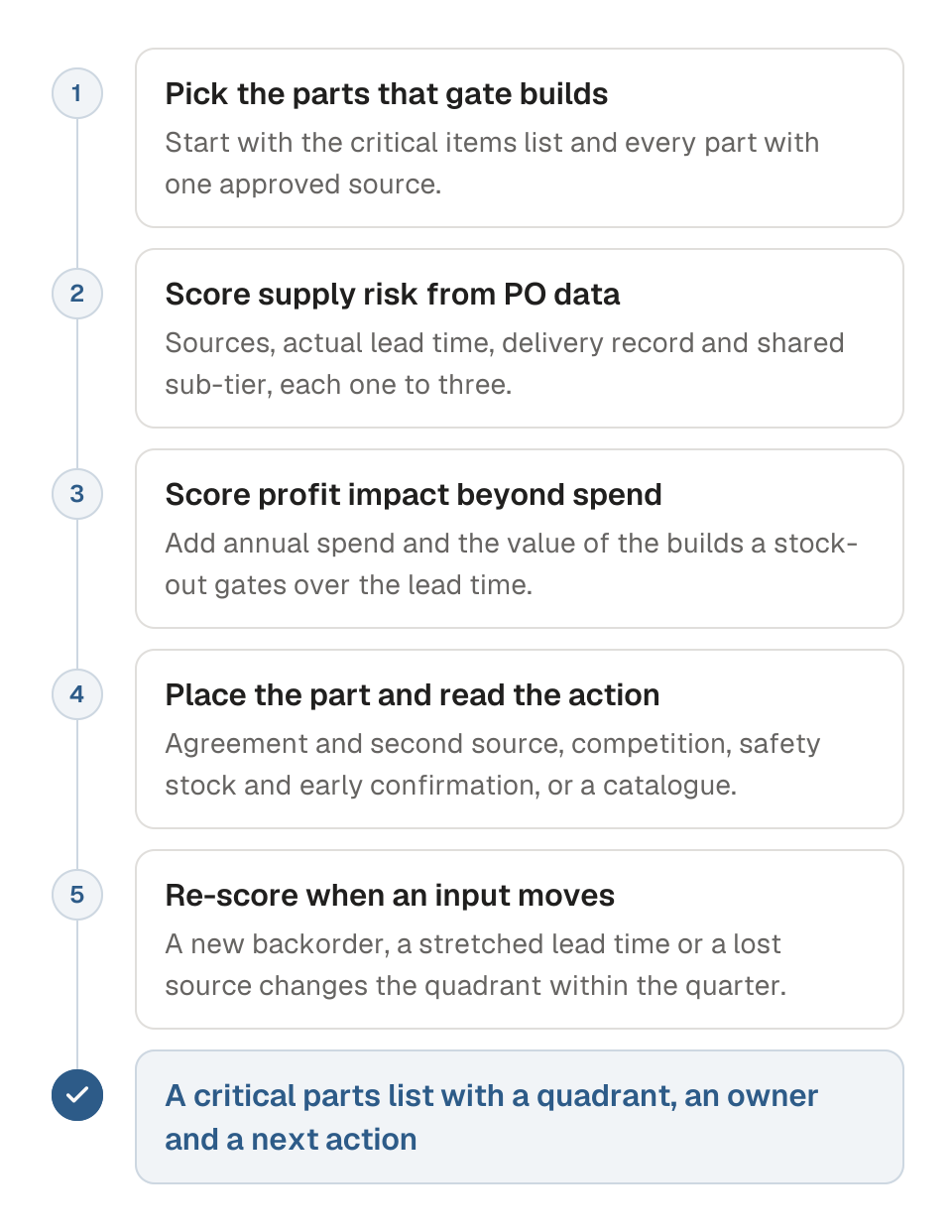
A fourth mistake is placing a part and then changing nothing. The matrix is a sorting step. The output is a list of parts with a quadrant, an owner and a next action. That list drives the sourcing work for the year.
How often should you re-score?
Re-score the whole set of critical parts once a year, in the planning cycle. Re-score a single part whenever one of its risk inputs moves. A supplier who starts backordering, a lead time that stretches past the quote, a sub-tier that closes, or a second source that drops the part: each changes a score within the quarter. Readiness signals catch most of these moves on open PO lines. When a part's supplier misses dates or puts lines on backorder, a readiness signal opens a task. Cartograph hands it to your team or Scout Agent, who gets the revised date and the cause from the supplier. A run of those tasks on one part is the trigger to move it a quadrant and change its approach. Supplier lead time covers how to measure the lead time that feeds the score.
Questions teams ask
Is the Kraljic matrix for suppliers or for parts?
For parts and categories. Score each part, then treat a supplier according to the parts you buy from them. A supplier can hold strategic and non-critical parts at the same time.
How many parts should you score?
Start with the parts that gate builds: the critical items list, or every part with one approved source. Scoring a whole item master at once produces a matrix nobody acts on.
What is a bottleneck item in the Kraljic matrix?
A part with low profit impact and high supply risk. It costs little and comes from one source, a long lead time or an unreliable supplier. A shortage stops the line, and the spend never justifies a second-source project. Protect it with safety stock, early confirmation and an engineering alternative.
Can a part move between quadrants?
Yes, and it should when the inputs move. A leverage part becomes bottleneck when two of its three sources exit the market. A bottleneck part becomes non-critical when engineering approves a standard alternative.
If your critical parts list has more bottleneck parts than one buyer can watch, talk to our team. Cartograph's readiness signals open a task when one of them slips.