

DFARS 252.225-7009: specialty metals requirements
What DFARS 252.225-7009 requires, paragraph by paragraph: the melt rule, six exceptions, the flowdown, and the mill-cert proof that passes review.
DFARS 252.225-7009 is the contract clause that requires specialty metal inside aircraft, missile or space systems, ships, tank or automotive items, weapon systems and ammunition to be melted or produced in the United States, its outlying areas, or a qualifying country. It also sets six exceptions, an alternative for commercial derivative military articles, and the text your subcontracts must carry.
Compliance turns on the melt, not on where a part was machined or assembled. This page walks the clause paragraph by paragraph and ends with the documentation checklist a reviewer expects. For the wider picture, including 252.225-7008 and the metal thresholds, see DFARS specialty metals.
What does DFARS 252.225-7009 require?
Paragraph (b) requires any specialty metal in items delivered under the contract to be melted or produced in the United States, its outlying areas, or a qualifying country, unless a paragraph (c) exception applies. Contracting officers use the clause above the simplified acquisition threshold for covered items, and their components, that contain specialty metal. DFARS 252.225-7009(b).
The covered items are aircraft, missile or space systems, ships, tank or automotive items, weapon systems and ammunition. When the item ordered is the specialty metal itself, such as bar or plate, the contract carries 252.225-7008 instead. DFARS 225.7003-5(a).
The clause has five paragraphs. Paragraph (a) sets the definitions, (b) the restriction and (c) the exceptions. Paragraph (d) offers another way to comply for commercial derivative military articles, and (e) sets the flowdown.
What each paragraph of 252.225-7009 asks of a supplier
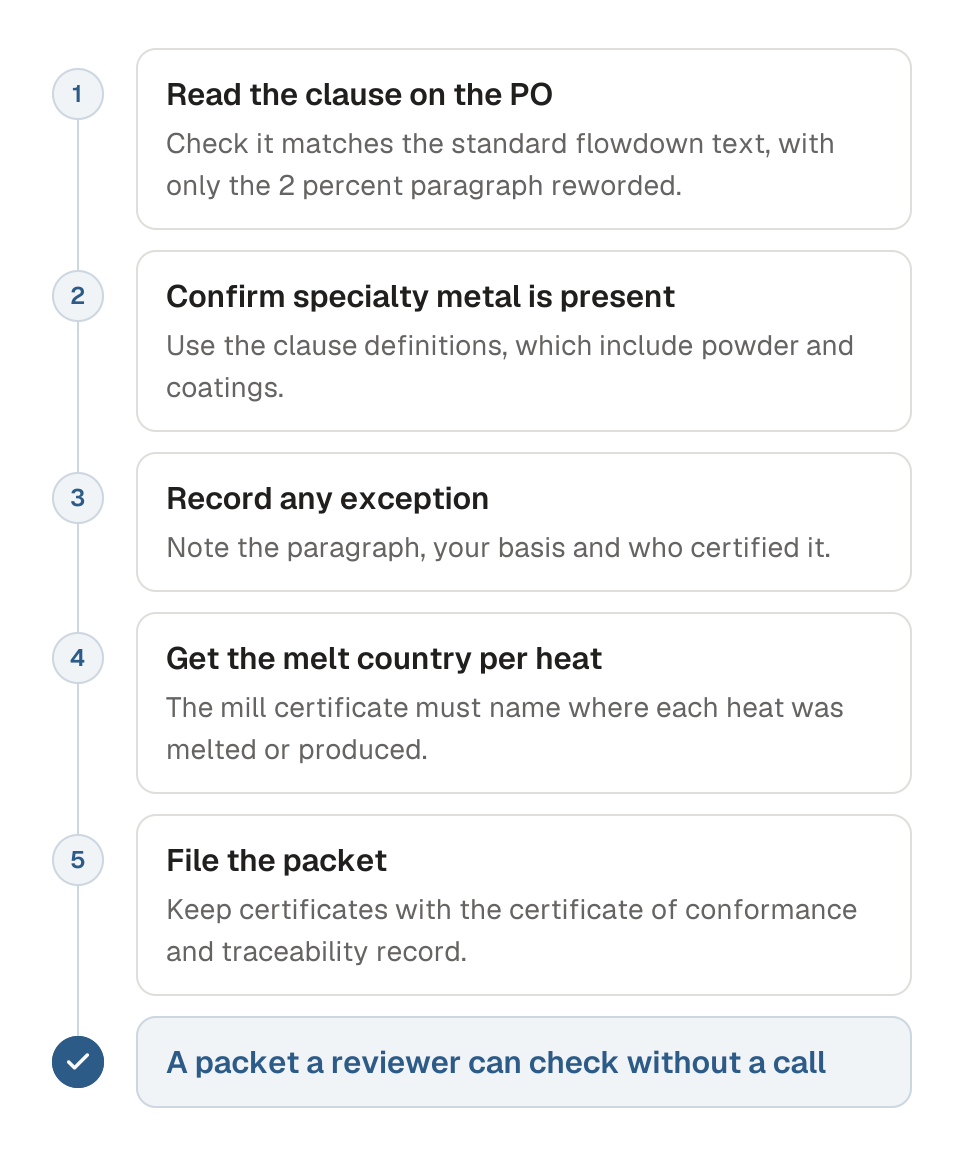
Table mapping the five paragraphs of DFARS 252.225-7009 to what each says and what a supplier does about it. Paragraph (a) defines specialty metal, produce and electronic component, so the supplier confirms whether the part contains covered metal. Paragraph (b) requires a melt or production location in the United States, its outlying areas or a qualifying country, so the supplier gets the melt country on each mill certificate. Paragraph (c) lists six exceptions, so the supplier records which one it relies on and who certified it. Paragraph (d) offers the commercial derivative military article alternative, which only the prime can use. Paragraph (e) sets the flowdown, so the supplier checks the clause on its purchase order matches the standard text.
| Paragraph | What it says | What the supplier does |
|---|---|---|
| (a) Definitions | Defines specialty metal, produce (atomization, sputtering, powder consolidation) and electronic component | Confirm whether the part contains covered metal, including powder and coatings |
| (b) Restriction | Specialty metal must be melted or produced in the United States, its outlying areas or a qualifying country | Get the melt country on the mill certificate for every heat |
| (c) Exceptions | Electronic components, COTS, commercial-product fasteners, qualifying-country manufacture, nonavailability, 2 percent minimal content | Record the exception, its paragraph and who certified it |
| (d) Commercial derivative alternative | The prime may buy enough domestic specialty metal instead, under a 252.225-7010 certificate | Nothing at sub-tier level; (e)(1) removes it from subcontracts |
| (e) Subcontracts | Paragraphs (a)-(c) and (e)(2) flow down, including commercial products, with only (c)(6) reworded | Check the clause on the purchase order matches the standard text |
Each paragraph of the clause creates one piece of supplier work. Only the prime can use paragraph (d).
Which definitions in 252.225-7009(a) decide coverage?
Two definitions decide most cases. "Specialty metal" covers steel over set alloy limits, nickel, iron-nickel and cobalt alloys with more than 10 percent other alloying metals, titanium and its alloys, and zirconium and its alloys. "Produce" means atomization, sputtering or final consolidation of non-melt derived metal powders, so powder and coatings face the same location test. DFARS 252.225-7009(a).
Tungsten and molybdenum aren't covered families of their own. They count only as alloying elements that can bring a steel or alloy over the limits. The full thresholds, and how samarium-cobalt magnets fit, are in what counts as a specialty metal.
The clause also defines "electronic component" narrowly. The term excludes the structural or mechanical parts of an assembly that contains one, and any high performance magnet used inside it. A housing or bracket around a circuit board is not an electronic component.
Which exceptions does 252.225-7009(c) allow?
Paragraph (c) lifts the restriction in six cases: electronic components, most COTS items, commercial-product fasteners whose maker meets a 50 percent domestic-melt purchase test, items manufactured in a qualifying country, metal covered by a domestic nonavailability determination, and up to 2 percent noncompliant specialty metal by weight. DFARS 252.225-7009(c).
| Exception | Paragraph | The limit that catches suppliers |
|---|---|---|
| Electronic components | (c)(1) | Excludes structural and mechanical parts of the assembly, and any high performance magnet inside |
| COTS items | (c)(2) | Mill products, forgings, castings, high performance magnets and fasteners bought on their own stay restricted |
| Commercial-product fasteners | (c)(3) | The fastener maker certifies that at least 50 percent of its specialty metal purchases for the year are domestically melted or produced |
| Qualifying-country manufacture | (c)(4) | The item itself must be manufactured in a qualifying country |
| Domestic nonavailability | (c)(5) | The government makes the determination under DFARS 225.7003-3, so a supplier can't declare it |
| 2 percent minimal content | (c)(6) | Counted against all specialty metal in the end item, and never available for high performance magnets |
Paragraph (c)(2)(ii) settles what "without modification" means for COTS. A COTS item keeps its exception once the next tier up accepts it unmodified, even if that tier later trims it, such as cutting the end off a screw or drilling an extra hole in a bracket. Specialty metal added after acceptance is restricted. When two COTS items are joined into something that isn't COTS, only the metal used to join them is restricted. DFARS 252.225-7009(c)(2)(ii).
No exception applies itself. Record which one you rely on, its paragraph and who certified it, so a reviewer can check the basis without asking.
What is the commercial derivative military article alternative?
Paragraph (d) lets a prime comply another way for items the contracting officer has named commercial derivative military articles, which are built on the same lines and supply chain as a commercial product. The prime certifies, under the 252.225-7010 provision, that it and its subcontractors will buy enough domestically melted or produced specialty metal during the contract. DFARS 252.225-7009(d).
The amount is the greater of two figures. One is 120 percent of the specialty metal the military article needs. The other is 50 percent of what the contractor and its subcontractors buy for the military article and the related commercial article. COTS content counts toward the requirement.
Paragraph (e)(1) removes (d) from subcontracts, so a sub-tier supplier can't use this route on its own. It works only through the prime's certification.
Does 252.225-7009 flow down to subcontractors?
Yes. Paragraph (e)(2) requires the prime to insert paragraphs (a) through (c) and (e)(2) into subcontracts for items containing specialty metal, including subcontracts for commercial products. The prime may change (c)(6) only to manage the 2 percent exception at the prime level, and may not alter anything else except the names of the parties. DFARS 252.225-7009(e).
A machine shop two tiers down therefore receives the same restriction and exceptions the prime signed, without the (d) alternative. If the clause on your purchase order has been reworded beyond the 2 percent paragraph, ask the buyer which text governs.
What must a mill certificate show for 252.225-7009?
The clause sets no certificate format, but a reviewer must trace each heat to a compliant melt without a phone call. A mill test report that names the producing mill, heat number, grade and chemistry still falls short if it leaves out the country where the metal was melted or produced. Require the melt country on the purchase order.
- Heat or lot number, the unique identifier for the melt
- Producing mill and melt country, the fact the clause turns on
- Qualifying country, for a melt outside the United States, checked against the DFARS 225.003 list
- Melt method (for example EAF, AOD or VAR) and any remelt practice
- Grade, alloy designation and temper
- Chemistry and mechanical test results, tied to the governing specification
- Purchase order and part number the certificate supports
A chemistry test can't prove melt location, because the same grade gets melted in more than one country. A certificate that is silent on melt origin leaves the lot unproven, even when the metal itself is fine. Mill test report covers what a compliant certificate looks like, and receiving inspection covers what to do when the paperwork arrives late.
German suppliers: US buyers ask for melt-number traceability, which German practice calls Kennzeichnung der Schmelznummer. The Schmelznummer on your Werkszeugnis or Abnahmeprüfzeugnis must match the heat number on the purchase order and on the part's traceability record. The certificate should also name the country of the melt. Our mill test report guide is also available in German.
How is 252.225-7009 different from 252.225-7052?
252.225-7009 asks where specialty metal was melted or produced, and accepts any qualifying country. 252.225-7052 covers certain rare earth magnets, tantalum and tungsten, and bars China, Russia, Iran and North Korea as sources, whatever the qualifying country list says. A samarium-cobalt magnet can fall under both clauses. DFARS 252.225-7052(b), (c).
| 252.225-7009 | 252.225-7052 | |
|---|---|---|
| Covers | Specialty metals: covered steels, nickel and cobalt alloys, titanium, zirconium | Samarium-cobalt and neodymium-iron-boron magnets, tantalum, tungsten |
| Test | Melted or produced in the United States, its outlying areas or a qualifying country | Not melted or produced in China, Russia, Iran or North Korea, and from January 1, 2027, not mined, refined or separated there |
| Main exceptions | Electronic components, COTS, the fastener 50 percent test, qualifying-country manufacture, nonavailability, the 2 percent rule | COTS end items within weight and mill-product limits, electronic devices, recycled neodymium-iron-boron magnets milled and sintered in the United States, nonavailability |
| Supplier question | Where was this heat melted? | Where was this material mined, refined, separated and melted? |
New contracts carry the deviation version of 7052, numbered 252.225-7961. The dates and exceptions are in DFARS 252.225-7052.
Documentation checklist to pass review
Before you ship against an order that carries 252.225-7009:
- Collect the mill test report for every heat in the shipment
- Confirm each certificate names the melt country, or get a supplemental statement from the mill
- Reconcile heat numbers across the certificate, the purchase order and your traceability record
- Attach the certificate of conformance for the finished part
- If you rely on an exception, record the paragraph, your basis and who certified it
- File the packet where the next audit or the next buyer can find it in minutes
Step 6 is the one teams skip. Your team can open each melt-source request as a task and hand it to Scout Agent, who follows up with the supplier by email and phone until the certificate arrives.
Questions teams ask
Who has to comply with DFARS 252.225-7009?
The prime contractor that signed it, and every subcontractor whose purchase order carries the flowed-down text for an item containing specialty metal. Distributors are covered the same way when their order carries the clause, and commercial-product subcontracts are not excluded. DFARS 252.225-7009(e)(2).
Can a subcontractor rely on the 2 percent rule?
Only with the prime's agreement. The contractor estimates the 2 percent in good faith across all specialty metal in the end item, so it is managed at the prime level, and (e)(2)(i) lets the prime reword (c)(6) in subcontracts for that reason. It never covers high performance magnets. DFARS 252.225-7009(c)(6), (e)(2)(i).
Does 252.225-7009 cover metal powder for additive manufacturing?
Yes, when the powder is a specialty metal and the printed part goes into a covered item. The clause counts atomization and final consolidation of non-melt derived powders as producing the metal. Ask the powder supplier where those steps took place, as well as where the metal was melted. DFARS 252.225-7009(a).
Does the clause apply below the simplified acquisition threshold?
Prime contracts at or below the simplified acquisition threshold don't carry it. Once a prime contract above the threshold does, the flowdown reaches every subcontract for items containing specialty metal, whatever the subcontract's value. DFARS 225.7003-3(a). DFARS 252.225-7009(e)(2).
Confirm clause applicability and any reworded flowdown with your contracting officer or customer. This guide is practical orientation, not legal advice.
If your team is building melt-source evidence into purchase orders for steel, titanium, nickel-alloy or cobalt-alloy suppliers, talk to our team.
Cartograph's articles are general information, not legal or tax advice. Check how the rules apply to your business with your legal or tax advisor.
Sources (7)
- DFARS 252.225-7009 Restriction on Acquisition of Certain Articles Containing Specialty Metals (JAN 2023)
- DFARS 252.225-7008 Restriction on Acquisition of Specialty Metals (MAR 2013)
- DFARS 225.7003-3 Exceptions
- DFARS 225.7003-5 Solicitation provision and contract clauses
- DFARS 225.003 Definitions (qualifying country)
- DFARS 252.225-7052 Restriction on the Acquisition of Certain Magnets, Tantalum, and Tungsten (MAY 2024)
- Class Deviation 2026-O0041, Revision 1, DFARS Part 225 including 252.225-7961 (JUN 2026)